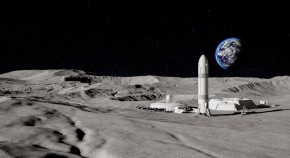
We argue that the next leap in lunar exploration must focus beneath the surface, seeking natural cavities as potential shelters for human habitation. Lunar exploration is transitioning from brief visits to long-term presence, raising the urgent need for protection against harsh surface conditions. We propose that subsurface lava tubes and impact-formed cavities could serve as ready-made safe havens, providing radiation shielding and thermal stability. Ground-penetrating radar (GPR) technology, deployed from rovers and orbiters, offers a means to detect and map these hidden structures on a global scale. We highlight recent research led by Chinese lunar missions from Chang’E-3’s first in-situ radar profiling to new data from Chang’E-4’s far-side rover, which revealed layered regolith and even a ~3 m void just beneath the Moon’s surface. We further discuss a novel “blind inversion†radar analysis method developed by Ding and colleagues to infer subsurface voids from limited data. In this perspective, we emphasize that a concerted effort to perform global radar sounding of the Moon’s subsurface is crucial for identifying stable underground habitats. Therefore, we advocate for a global-scale orbital penetrating radar mission to comprehensively map subsurface structures across the Moon. Such natural shelters could drastically lower the cost and risk of establishing a human base on the Moon, accelerating humanity’s march towards a permanent off-Earth presence.
- Chunyu Ding
- Jiangwan Xu
- Changzhi Jiang